
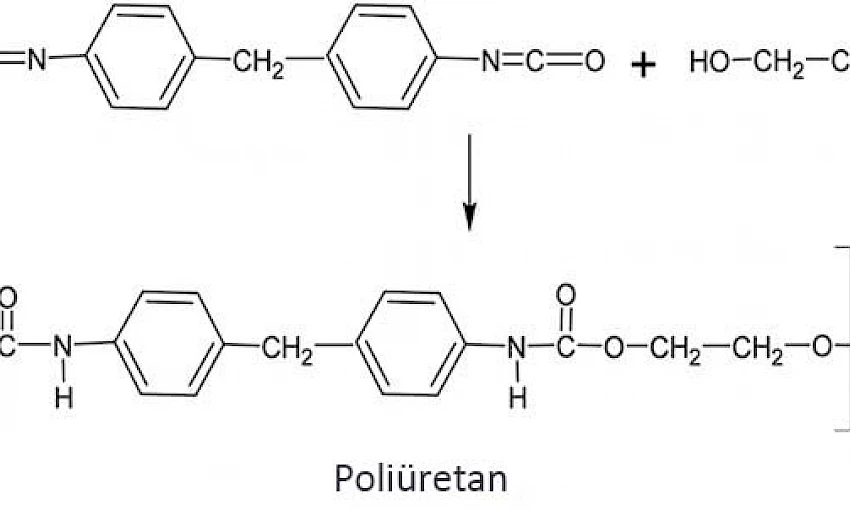
What is Polyurethane?
Look around you in the modern world; from the sofa you sit on to your home’s insulation, and from the soles of your shoes to your car's steering wheel, you will find an invisible hero: Polyurethane. It is not a single substance, but a synthetic polymer formed through the controlled reaction of two primary components. In the industry, you will typically hear these referred to as "Component A" and "Component B":
-
Polyol (Component A): The component that provides flexibility and softness to the mixture, carrying free hydroxyl (OH) groups within its structure.
-
Isocyanate (Component B): The component that, when combined with polyol, triggers an exothermic (heat-releasing) reaction, causing the material to harden.
When these two substances combine, "carbamate linkages" are formed at the molecular level. The secret behind polyurethane's ability to transform from a rock-hard panel into a sponge as soft as cotton lies within this bond structure.
What is Polyurethane Foam?
Polyurethane foam is a porous material created when liquid polyol and isocyanate components react in the presence of a blowing agent, expanding to many times their original volume. The thousands of tiny air bubbles (cells) formed during this process make the foam both lightweight and insulating.
Not all foams are created equal. Based on their intended use, foams are divided into two main categories:
-
Open-Cell Foams: In these, the cells are interconnected, allowing air and moisture to pass through. They are lighter and are predominantly used today in furniture cushions and sound insulation.
-
Closed-Cell Foams: The cells are completely sealed and trap specialized insulating gases inside. They are waterproof and possess the highest thermal insulation values on the market. They are an indispensable solution for construction and cold storage facilities.
What is Polyurethane Coating?
From floors to roofs, and from metal surfaces to exterior facades, the primary professional solution for protection is Polyurethane Coating. This technology combines durability with aesthetics, extending the lifespan of surfaces while simultaneously providing waterproofing and chemical resistance.
Who Discovered Polyurethane?
It was first synthesized in 1937 by Otto Bayer, who produced it through the reaction of diisocyanate with diol.
Why was Polyurethane Developed?
Polyol + Isocyanate + Catalyst + Blowing Agent $\rightarrow$ Polyurethane Foam
Polyol provides flexibility, Isocyanate builds the structural skeleton, the catalyst accelerates the process, and the blowing agent adds volume. When these four components are combined in the correct proportions, they create the polyurethane we use to solve countless problems today.
What are the Advantages of Polyurethane?
-
High Thermal Insulation: Thanks to its closed-cell structure, it has the lowest thermal conductivity coefficient on the market, providing up to 50% savings on energy bills.
-
Lightweight and Structural Strength: Despite its very low density, it can support high loads. This feature adds durability to buildings and vehicles without adding significant weight.
-
High Flexibility: It exhibits elasticity against impacts or stress and returns to its original form once the pressure is removed; this makes it unique for the furniture and footwear industries.
-
Chemical and Biological Resistance: It is highly resistant to oils, solvents, mold, and bacteria. Consequently, it is used safely in both industrial flooring and medical fields requiring hygiene.
-
Seamless Water and Moisture Insulation: Especially in coating and spray forms, it creates a seamless (jointless) layer on the applied surface, completely preventing water leaks and dampness.
-
Long-lasting and Economical: Highly resistant to wear and corrosion, it maintains its form for years without maintenance, reducing investment costs in the long run.
-
Design Freedom: Since it can be applied as a liquid, it can take the shape of even the most complex molds, offering limitless design possibilities from automotive to giftware.
How is polyurethane produced?
Polyurethane is produced in chemical plants where isocyanate and polyol components are mixed in high-pressure machines and poured into molds or lines. Aces Process specializes in turnkey plant installations for these complex production processes, from reactors to dosing systems. With our engineering expertise, we implement world-class, customized polyurethane production lines that deliver maximum efficiency and precision.
Translated with DeepL.com (free version)
In this article, we accompanied the revolutionary journey of polyurethane—the invisible architect of the modern world—from its start in Otto Bayer's laboratory in 1937 to its presence today in everything from our roofs to our shoe soles.
Explore the world of polyurethane and its diverse applications!
Writer:
Professor Doctor Mustafa Yaşar
Industrial Design Engineer
Son Blog Yazıları


